Why Did Japan Backlash Over Changing a Train Mascot? The Suica Penguin Controversy
A Nationwide Reaction to a Single Mascot Change
"Not cute." "Terrifying." "It looks completely soulless."
These were just a few of the intense reactions that flooded Japanese social media when rumors and announcements began circulating about a potential redesign of the beloved Suica Penguin. Online petitions demanding to keep the original mascot quickly gathered around 27,000 signatures.
To an outside observer, this fierce backlash might seem absurd. Why would a nation react so strongly—almost grieving—over a cartoon penguin printed on a public transit smart card? Is this merely a critique of poor graphic design, or does it reveal a much deeper emotional loss?
To answer this, we need to look beyond the surface of Japan’s famous "cute culture" and explore how mascots function not just as corporate tools, but as emotional anchors in daily Japanese life.
Table of Contents
Beyond "Kawaii": The Diverse World of Japanese Mascots
When foreigners think of Japanese characters, iconic figures like Hello Kitty or Pikachu usually come to mind—characters designed to be universally adorable. However, Japan’s domestic mascot culture is far more nuanced, encompassing several distinct subgenres:
- Yuru-chara (ゆるキャラ): "Relaxed" or "loose" regional mascots created to promote local tourism, often possessing quirky or unpolished designs.
- Kimo-kawa-chara (キモかわキャラ): Characters that blend kimoi (gross/creepy) and kawaii (cute), unsettling or bizarre at first glance, yet strangely endearing.
Sento-kun: The Pioneer of "Kimo-kawa"

Take Sento-kun, the official mascot created for Nara Prefecture’s 1300th anniversary. Featuring the body of a young Buddhist monk with deer antlers growing out of his head, Sento-kun was initially met with intense public backlash. Critics called him "creepy" and "blasphemous." Yet, over time, his odd presence became familiar, and he was embraced as a beloved local icon.
Myaku-Myaku: From Unsettling to Fan Favorite

Similarly, Myaku-Myaku, the official mascot for Expo 2025 Osaka, faced heavy initial criticism for its cell-like, multi-eyed design. Initially slammed on social media as "monstrous," Myaku-Myaku seemed like an immediate failure. However, as it began making real-world appearances—showing surprisingly polite and charming physical movements in its mascot costume—the public narrative shifted. What started as shock gradually transformed into a strange, protective affection as netizens grew accustomed to its bizarre charm.
In Japan, "weird" or unsettling mascots are usually given space to earn public affection over time. So why didn't a new Suica mascot candidate receive that same grace?
The Suica Penguin: Not a Guest, But a Resident of Daily Life
The fundamental difference lies in presence and permanence.
Characters like Sento-kun or Myaku-Myaku arrived as outsiders—new visitors asking for public acceptance. The Suica Penguin, however, was already a permanent resident in the daily routine of millions.
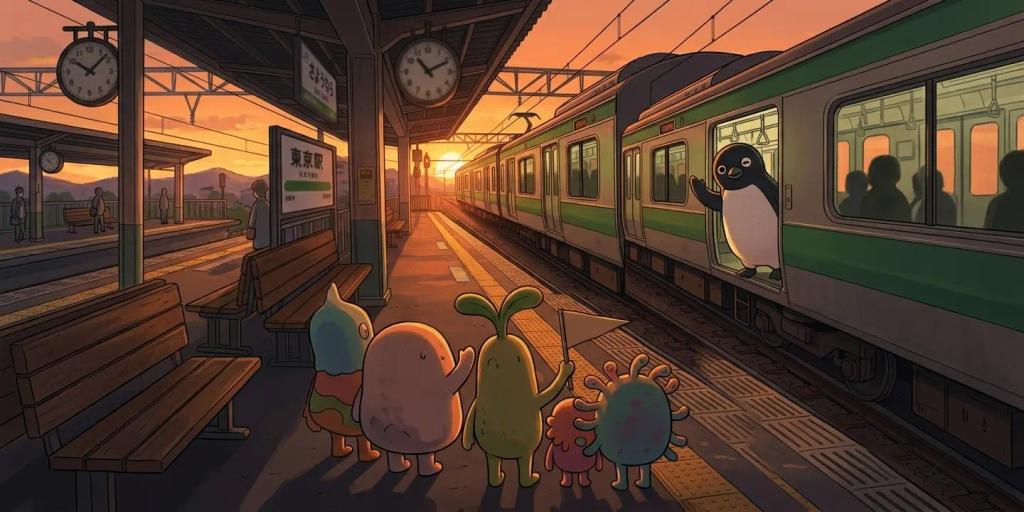
Since its introduction by JR East in 2001, the Suica Penguin has been quietly embedded in everyday Japanese infrastructure. Every morning, millions of commuters swipe their Suica card or tap their phone at train turnstiles. The little penguin glides across payment screens, greets passengers on station banners, and appears on convenience store receipts.
For over two decades, the penguin became a subconscious symbol of safety, efficiency, and comfort in the chaotic daily commute of Tokyo and surrounding areas. He was not just a marketing gimmick; he was part of the urban landscape.
Replacing him felt less like a brand update and more like removing a familiar piece of street architecture—or losing an old friend who had quietly stood by commuters through stressful workdays for twenty years.
Mascots as Social Anchors in Public Spaces
The fierce defense of the Suica Penguin reveals something profound about modern Japan: mascots in Japan often serve as public emotional infrastructure.
In a dense, fast-paced society, mascots function as gentle buffers. They soften the coldness of bureaucratic institutions, public transit systems, and corporate services. They give public spaces a human—or in this case, penguin—face.
The public outcry was never just about a preference for one drawing over another. It was a visceral reaction to having a small, reassuring constant suddenly removed from daily life. The Suica controversy proves that in Japan, a mascot is not just a logo—it is an anchor of emotional comfort in the public sphere.

Categories
Related Articles

Beyond "Bon Appétit": The Real Meaning of Itadakimasu and Gochisosama
Onimusha: Way of the Sword — Musashi, Oni, and Kyoto's Hidden Lore

"Shokuyoku no Aki" to Your Own: How Japanese People Theme the Fall Season