Beyond "Bon Appétit": The Real Meaning of Itadakimasu and Gochisosama
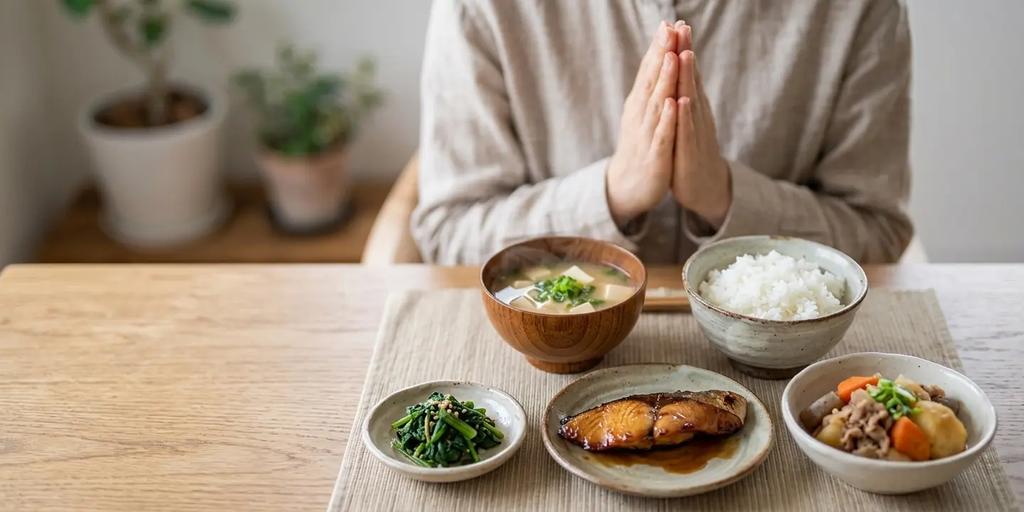
If you’ve watched anime, dined at a Japanese restaurant, or visited Japan, you’ve almost certainly heard people say “Itadakimasu” before a meal and “Gochisosama” after it.
In textbooks and translation apps, these terms are nearly always glossed as "Bon appétit" and "Thank you for the meal." While those translations give you a general idea of when to say them, they miss the entire cultural philosophy behind the words.
In fact, if you take those English equivalents literally, you might end up confused by everyday Japanese behavior. Why do Japanese people clasp their hands and whisper "Itadakimasu" when sitting alone in their apartment with a microwave meal? There is no chef to thank, and nobody else is sitting at the table to wish a good appetite to.
To understand why, we need to look beyond surface-level translations and unpack the deep sense of gratitude—and nature-centered worldview—baked into Japanese food culture.
Table of Contents
The Core Concept: What the Words Actually Mean
To see why these phrases are far more than politeness formulas, let’s break down their literal roots.
Itadakimasu (いただきます)
- Literal Meaning: "I humbly receive."
- The Linguistic Root: The phrase derives from the humble verb itadaku (頂く). Beyond its general meaning of "to receive," the verb has historical ties to the physical action of raising a gift above one's head to show gratitude. As a humble expression, its usage expanded over the centuries to cover eating and drinking as well.
When you say Itadakimasu, you aren't wishing someone a pleasant meal. You are performing an act of humility, acknowledging that you are on the receiving end of a gift.
Gochisosama (ごちそうさま / 御馳走様)
- Literal Meaning: "You were running around (to prepare this)."
- The Linguistic Root: Look at the Kanji: 馳 (to run fast) and 走 (to run). Centuries ago, before refrigerators, delivery apps, or supermarkets existed, gathering ingredients for guests required immense physical effort. The word chisō originally referred to running around or going to considerable effort to arrange something, and came to mean going to the trouble of preparing a meal or entertaining a guest.
Adding the honorific prefix go- (御) and suffix -sama (様) transforms those physical efforts into an expression of deep appreciation: "Thank you for all the trouble and effort you went through to prepare this feast."
The Cultural Context: Why Japanese People Clasp Their Hands
This brings us back to our original question: Why say this when eating alone?
The key is realizing that the gratitude expressed in Itadakimasu isn't directed exclusively at human beings. It is directed at the food itself.
1. Gratitude for Sacrificed Life
While Itadakimasu evolved as a everyday polite phrase, its modern cultural nuance is deeply intertwined with Japan’s traditional worldview—one shaped by Shinto, Buddhism, and a long-standing reverence for nature. In this mindset, every component of a meal—not just meat or fish, but vegetables and grains as well—is viewed with a sense of respect.
In Western traditions, saying grace often means thanking God for the nourishment or the food provided. In Japan, however, Itadakimasu is a direct nod to the sacrifice of those lives. It acknowledges a simple, sobering reality: to sustain your own life, you are consuming the lives of others.
Itadakimasu is a quiet acknowledgement of that exchange. You are receiving the life of the ingredients, acknowledging their sacrifice with a brief moment of respect. This is why dining solo doesn't change the habit: the life on your plate is still present, regardless of who else is sitting at the table. Over time, Itadakimasu has simply become a familiar, second-nature mealtime expression of gratitude—not just a polite gesture directed at the person who cooked the food.
Note: When dining alone in public—such as at a ramen shop or a food court—many Japanese people will perform a subtle, almost invisible gesture: a tiny nod with palms pressed together for just a second, or a quiet whisper of "itadakimasu" under their breath. It’s a personal moment of gratitude rather than a public performance.
2. The Gassho Gesture: Respect, Not Prayer
When Japanese people say Itadakimasu, they usually perform gassho (合掌)—pressing their palms together in front of their chest, sometimes holding their chopsticks gently between their thumbs.
Western readers often mistake this gesture for a religious prayer, similar to saying grace. In Japan, however, gassho is a universal posture of reverence and gratitude. Although pressing the palms together can have religious associations in Japan, when people use the gesture before a meal, it can simply accompany an expression of gratitude. It isn't a prayer to a higher power asking to bless the meal; it is a direct nod of respect to the ingredients on the table and the invisible line of people—farmers, truck drivers, cooks—who brought that meal to fruition.
Practical Examples: How to Use Them Naturally
Here is how these phrases play out in real life, along with the subtle social cues native speakers use.
Example 1: Starting a Meal with Friends or Colleagues
When food arrives at the table, it is polite to pause briefly, bring your hands together, and say the phrase out loud before taking your first bite.
Romaji: Samenai uchi ni, itadakimasu!
Translation: "Let's dig in before it gets cold!"
In casual settings with friends, a quick palm-press accompanied by a nod and a cheerful "Itadakimasu!" sets a warm, appreciative tone for the table.
Example 2: Expressing Thanks After Eating
Once you've finished your meal, bring your hands together once more for Gochisosama.
Romaji: Gochisosama deshita. Sugoku oishikatta desu!
Translation: "Thank you for the meal! It was absolutely delicious."
Gochisosama deshita is the standard polite form commonly used after a meal. Use Gochisosama deshita when speaking to restaurant staff, a host, or someone who treated you to a meal.
Example 3: Expressing Gratitude When Someone Else Pays
Gochisosama doubles as the natural way to thank someone who treated you to lunch or drinks.
Romaji: Bucho, kyou wa gochisosama deshita!
Translation: "Manager, thank you so much for treating me today!"
In this social context, you are thanking them for their financial generosity—acknowledging that they took care of you just like a host running around to prepare a feast.
Key Takeaways
Next time you sit down to eat in Japan or at a Japanese restaurant, keep these core ideas in mind:
- Itadakimasu is a two-way exchange: It isn't just a word of gratitude to the server. It is a humble acknowledgement that you are receiving living ingredients and the effort of the people who prepared them.
- Gochisosama honors the effort: It recognizes the hidden work behind a meal—the "running around" required to bring food to your plate.
- The hand gesture is about respect, not religious ritual: Pressing your palms together briefly isn't a strict religious obligation; it's a simple, mindful gesture of gratitude.
You don't need flawless grammar to show respect at the dinner table. Even as a visitor or language learner, simply pressing your palms together and offering a gentle "Itadakimasu" shows a deep understanding of Japanese etiquette that native speakers will instantly recognize and appreciate.
Want to Explore Deeper?
If learning about the real meaning of Itadakimasu and Gochisosama got you curious about Japanese culture and language, check out these related guides on Japanese Universe:
- 美味しそう! Should I say Oishii or Oishisou? : Learn the difference between 美味しい and 美味しそう, and how to use ~そう to describe things that seem a certain way.
- 調理方法 – 7 Essential Verbs for Japanese Cooking : Master the essential Japanese cooking verbs — 焼く, 炒める, 揚げる, 煮る, 炊く, 茹でる, and 蒸す — and learn when to use each one.
- 旨み – How do you say Savory in Japanese? : Discover how to express "savory" in Japanese, from 旨味 (umami) to other natural ways to describe rich, flavorful food.
Categories
Related Articles

ありがとうございます vs. ありがとうございました

Is ありがとう rude? How to say Thank you in Japanese
調理方法 – 7 Essential Verbs for Japanese Cooking
