Tanabata (七夕) – Japan’s Festival of Stars, History and Symbols behind Wishes and Weaving
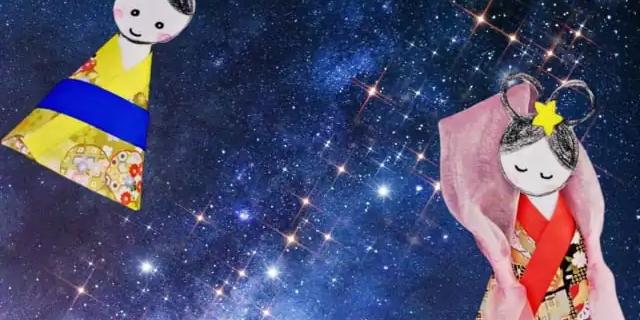
Tanabata in Japan happens every year on July 7th. It is a time to celebrate the tale of two galactic deities, Orihime and Hikoboshi. It has it’s origins in China but Japan has added it’s own twist to this tradition. Let’s take a look.
Table of Contents
The Story of Orihime and Hikoboshi – Star-Crossed Lovers of the Milky Way
At the heart of Japan’s Tanabata Festival is a timeless legend.
Orihime (織姫), the Weaving Princess, was the daughter of Tentei (天帝), the Sky King. She worked tirelessly weaving fabric along the Heavenly River—what we now call the Milky Way. Tentei introduced her to a diligent cowherd, Hikoboshi (彦星), and the two fell in love. But after marrying, Orihime stopped weaving and Hikoboshi neglected his cattle.
Furious, Tentei separated them, placing them on opposite sides of the Milky Way—allowing them to meet only once a year, on the seventh night of the seventh month: Tanabata (七夕).
Each year on that night, a flock of magpies forms a bridge across the stars so they can reunite. But if it rains, the river swells and the lovers must wait another year. The rain, they say, is the tears of Orihime and Hikoboshi.
For Japanese language learners, this myth offers rich vocabulary:
- Orihime (織姫): “Weaving princess” (織 = weave, 姫 = princess).
- Hikoboshi (彦星): “Cowherd star” (彦 = young man, 星 = star).
- Amanogawa (天の川): “River of the heavens” or “Milky Way” (天 = sky, 川 = river).
The Chinese Origins: Qixi Festival and Kikkōden (乞巧奠)
Tanabata in Japan comes from the Chinese Qixi Festival also known as the Qiqiao Festival. is a Chinese This is a celebration that commemorates the annual reunion of Zhinü and Niulang according to Chinese mythology. This holiday celebrated women’s craft skills, especially weaving and sewing, and honored Zhinü, a weaving goddess who corresponds to Japan’s Orihime. Qiaiao entered Japan in the Nara period, Then the Japanese name of the festival became Kikkōden (乞巧奠) and initially people in the Imperial court observed it, with noblewomen engaging in elegant weaving rituals under the stars.
These two characters are personifications of two stars. First, Vega, the primary star of the constellation Lyra represents the weaver girl Zhinü. Next the star Alter in the Aquila constellation symbolizes Niulang or the Ox-herder. Since these stars show up in the summer night, Chinese mythology came up with the tale of the two meeting only once a year on the 7th day of the 7th month in the lunar calendar. Nowadays though, in Japan it would be the 7th day of the 7th month of the lunar calendar. Which we will talk about later.
Native Japanese Traditions: The Loom Maiden Tanabatatsume (棚機津女)
Before the Chinese myth arrived, Tanabata already had a sacred place in native Japanese folklore.
The word Tanabata (棚機) originally referred to a ritual loom, used by young shrine maidens chosen to weave garments in solitude by the river as offerings to the gods. These girls were called Tanabatatsume (棚機津女 / たなばたつめ)—loom maidens.
棚機津女 – Tanabatatsume, the origin of the name Tanabata
Originally, the name Tanabata referred special weaving machine. Chosen girls who would weave kimono with this machine. They would shut themselves away in a small weaving house by the river and weave kimonos as an offering to the gods or kami. These were the 棚機津女たなばつめ (Tanabatatsume). The girls would weave on the night prior to Tanabata then the next day people would purify themselves at the water side.
This tradition also has a story behind it. One of these Tanabatatsume were weaving a kimono for a water god. After making him a kimono, he came done to the river and then the Tanabatatsume became his wife.
So today, the word 七夕 (Tanabata) took it’s name from the Tanabatatsume, and added the Kanji 七夕 which means seventh night.
Tanabata’s Fusion and Growth in Japan
The Chinese Kikkōden and the native Tanabatatsume traditions gradually merged. During the Heian and Edo periods, Tanabata became a seasonal celebration not just for nobles, but for the general public.
Though the lunar calendar originally placed Tanabata later in the summer, today most regions of Japan celebrate it on July 7th. Some places like Sendai still follow the lunar calendar and observe it on August 7th.
Tanzaku and Modern Celebration
The most iconic tradition of Tanabata today is writing wishes on colorful paper strips called tanzaku (短冊).
People of all ages write down their hopes—whether for love, success, or passing exams—and tie them to bamboo branches, which symbolize resilience, flexibility, and growth.
You’ll see bamboo wish trees in homes, schools, train stations, and shopping arcades throughout early July. Some wishes are poetic, others funny or heartfelt, but all carry the same feeling: hope that, like Orihime and Hikoboshi, our desires may cross the heavens and come true.
The Colors and Symbolism behind Tanzaku
On Tanabata, it is customary to write your wishes on these strips of paper, known as tanzaku and hang them on bamboo branches.
But, these are not just random colors. The colors of these strips of paper have meanings.
The five traditional colors of the tanzaku correspond to the five elements.
- 木 ー Wood (Green)
- 火 ー Fire (Red)
- 土 ー Earth (Yellow)
- 金 ー Metal (White)
- 水 ー Water (Purple)
This derives from the tradition Chinese theory of Yin-Yang and the Five Elements. The theory of Yin-Yang and the Five Elements is based on the idea that everything in nature is classified into five categories: wood, fire, earth, metal, and water.
Originally black was the color for water. But in Japan, purple is a noble color, and replaced the less preferred color black. Also the color green in the past was called blue, so it is believed that the color changed later to green.
In addition to the five colors, this “five elements theory” also applies to the “five virtues benevolence, propriety, faith, righteousness, and wisdom,” which mean that people should live earnestly. They also say that writing wishes on the color that best suits the wish will make it easier for the wish to come true.
- 仁ー Benevolence (Wood: Green)
- 礼ー Propriety (Fire: Red)
- 信ー Faith (Earth: Yellow)
- 義ー Righteousness (Metal: White)
- 智ー Wisdom (Water: Purple)
However, in modern Japan, people still make wishes on tanzaku, but the color of the tanzaku is not so important anymore. On the other hand, the decorations and strips of paper on bamboo bamboos have gradually become more showy, and festivals such as Tanabata in Sendai and Hiratsuka have become more gorgeous, with large streamers and paper crafts decorated on them.
Tanabata is a rare blend of cosmic myth, handmade tradition, and heartfelt desire—a ritual that connects stars and strangers through hope. From the tragic romance of Orihime and Hikoboshi to the woven prayers of ancient shrine maidens, every detail of the festival carries meaning that’s easy to miss but deeply rewarding to rediscover.
七つ飾り – The 7 Traditional Tanabata Decorations and Their Meanings
Tanzaku are the most iconic but not the only decoration you see during Tanabata. While the romantic legend of Orihime and Hikoboshi is the heart of Tanabata, the soul of the festival is found in its decorations—each one rich in symbolism and intention. Known as the 七つ飾り (nanatsu kazari) or Seven Ornaments, these handmade decorations aren’t just for show—they represent age-old wishes for health, prosperity, skill, and order.
Here are the seven most common decorations you’ll find hanging from bamboo branches during Tanabata, and what they mean:
1. 短冊(たんざく) – Tanzaku: Wishes on Paper
We already know about these. These are the most iconic Tanabata decorations—colorful vertical strips of paper where people write down their hopes, goals, or personal dreams.
2. 紙衣(かみころも) – Kamigoromo: Paper Clothing
Miniature paper kimono-like garments, shaped to resemble human clothing, are hung to symbolize:
- A wish for better sewing and craft skills
- Protection from illness or disaster, like a paper talisman
- A symbolic offering of “lending clothes” to Tanabata deities
It’s believed the paper clothing takes on misfortune in your place, similar to ancient Shinto purification rites. This is known as 身代わり (migawari), literally Body Substitute.
The tradition of hanging paper clothing traces its origins to an old belief: that on Tanabata, people would “lend clothing” to the weaving star deity as a symbolic offering. During the Edo period, literature like Ihara Saikaku’s Kōshoku Gonin Onna (1686) recorded a custom where people would hang newly made, never-worn kimonos—借小袖 (karikosode)—folded in elaborate layers on display during the festival. The idea was to lend these garments to Orihime (織姫), the celestial weaving maiden, as a sign of reverence and seasonal beauty.
Over time, this practice shifted from displaying real garments to making paper versions. By the late Edo period and well into the Showa era, families—especially those with young girls—began crafting and displaying miniature 紙衣 made of colored paper. Children would even sew them by hand as part of learning household arts. It marked a transition: from noble ritual to children’s cultural practice, and from aristocratic refinement to community creativity.
3. 折鶴(おりづる) – Orizuru: Paper Cranes for Longevity
These origami cranes are folded to wish for long life and good health, especially for grandparents and family. Cranes in Japanese folklore live for a thousand years, making them a natural symbol of endurance and care across generations.
4. 巾着(きんちゃく) – Kinchaku: Drawstring Purse
This decoration takes the shape of a small pouch or coin bag, symbolizing:
- Wealth and financial prosperity
- Good fortune in business and trade
Historically used as a wallet, the 巾着 (kinchaku) is to represent keeping your purse tightly closed to avoid splurging on stuff to save your money for savings and prosperity.
5. 投網(とあみ) – Toami: Net Decorations
Symbolizing fishing nets, these decorations express hope for:
- Abundant food and never going hungry
- A good catch—whether in fish, opportunities, or life
The net represents both provision and skillful effort—as well as the idea of “scooping up” blessings.
6. 吹き流し(ふきながし) – Fukinagashi: Streamers for Craftsmanship
These long, flowing streamers represent the threads woven by Orihime, the celestial weaver. They honor and wish for:
- Improvement in weaving and artisan skills
- Growth in creativity, artistry, and discipline
The imagery comes from bundles of colored thread used in traditional looms.
7. くずかご(くずかご) – Kuzukago: Trash Basket
Often made from woven paper strips, this small symbolic waste basket serves as a reminder of cleanliness, order, and frugality.
Japanese use it to collect paper scraps from making the other decorations, symbolizing:
- Tidiness and good habits
- A wish to avoid wastefulness or carelessness
It’s a humble but powerful message that even joy and celebration should be accompanied by mindfulness.
July in Japan
Well that is what Tanabata is all about in Japan. There still is more to see in July though if you are visiting Japan. From the Gion Festival in Kyoto, to Lavender displays in Hokkaido, this season has given birth to many traditions and rich culture like what you see during Tanabata. If you are interested check it out! I wrote a who article about what you can expect during this month.